Friday, 7 October 2011

Post 7: additional pre-production

Location reece


Power- there are many plug sockets around so we can use them for extra lighting.  
Lighting-there are many windows where natural lighting can come in so we don’t think we will need  extra lighting.
Sound-the liabary is a very popular place so we plan to do it after school where it should be reasonably empty.


Theese are images of a few risks that we need to be aware of.


Risk assesment


Whilst walking in the door there is a mat we may trip over it
Make sure the mat is securely on the floor               
The table leg you may trip over
Make sure you stay away from the table and are aware where it is
The chair leg you may trip over
Make sure you stay away from the chair and are aware where it is
The photocopier is by the door and may catch a piece of clothing on it
Stay away from it.
We may knock over the tri-pod
Watch where it is and keep away from it
The doors may open and hit some one
Make sure no one is near the doors whilst opening.
We may trip over the wires
Make sure wires are securely on the floor


Shooting Schedule


Day
Period
Start Time
Scene
Shot
Tuesday 11th October 2011
After school
3:15
1 and 2
All shots completed


Mis-En-Scene Description

Set design/location
For our preliminary task we have be set the continuity task. We have decided to set it in the library at our school. We have chosen the library as it is very realistic as we have chosen to do our short clip about 3 teenagers that attend 6th form. Therefore the library achieves the idea of it looking like a school. We will not need to change any of the mis-en-scene as we will be surrounded by books. The library is very large and there is enough room for filming. There also are desks in the library which we aim to be using along with the chairs.       

Lighting
The library has natural light, there are numerous small windows around the library that regularly give light and also a door that will give us natural lighting from the corridor. There is also artificial lighting from numerous lights on the ceiling that we plan to use if the natural light isn’t bright enough.
    
Character movement
At the beginning of the filming, CHARLEY will be standing outside the corridor holding a letter; she will then walk into the library. BOBBI will see charley and calls her over then BOBBI will leave KATIE-MAI and CHARLEY remain at the table and argue. CHARLEY then runs out and slams the door, when then will cut to credits.
We have chosen this movement as it is very realistic to what teenage girls would do and how they would behave.

Props
During our filming we will use a letter, a desk with books, paper and pens on, three chairs place around the table for each girl. These props all help us create the feeling of three girls studying in a library 

Hair and make-up
BOBBI: Hair: Tied up      Make-up: N/A
KATIE-MAI: Hair: straightened down     Make-up: natural
CHARLEY:  Hair: Tied up     Make-up: a lot of make up
We choose this make up as it represents ourselves. Also we wanted Charley to be the stereo-type of a ‘chav’.


Cast and Crew Costume and Props list.


Costume and props-
All actors will have there nowmal clothes apart from Charley who will wear large earings.
We will use- 3 chairs, a desk, work on the table and stationary. All of theese are already in our location.
Cast and crew-
CHARLEY-filming and acting
BOBBI-filming and acting
KATIE-MAI- filming and acting

Costume-


Here is our original idea for BOBBI'S character TAYLOR we didn't want her to stand out too much so we made her a tomboy in comparison to ALICE'S 'girly' image and CHANTELLE'S 'chav' stereotype, there was no make-up needed for this character and overall the character's image worked well when filming.

Here is our original idea of my character ALICE we wanted her to look sweet and fun and natural in comparison to CHARLEY'S character CHANTELLE I believe this did work as there was an obvious contrast between characters and the outfit worked well with the character.
Here is our general idea of what we wanted CHARLEYS costume to look like when she was playing CHANTELLE we tried to keep it in the stereotype of a 'chav' and with her make-up we believe we did create a realistic look for her character


Tuesday, 4 October 2011

Post 6: storyboard and shot list

Shot
Description
Shot size
1
Charley is outside holding the letter looking upset.
The reason why we want this shot is because we want charley to be seen a venerable.
High angle medium long shot
2
Charley walks into the library, the reason why we choose this shot was so you  get an idea about the location 
Long shot
3
Bobbi spots Charley and waves at her and calls her over. We use a medium long shot so Charley and Bobbi are in the shot.
Medium long shot
4
This shot will show all three of us sitting together. We will have a medium shot so we will all fit in the camera
Medium shot
5
This shot will show Bobbi saying bye we will use a medium long shot so you also see her walking off set
Medium close up
6
Charley will now start crying. We will use an extreme close up to show charley crying.
Extreme close up
7
Katie keeps asking why Charley is upset; we will have a close up on Katie’s facial expression.
Close up
8
Charley has her hands over her face and tells Katie she is pregnant; we will use a close up to show this.
Close up
9
Katie gets angry and slams hands on the table; we will use a medium close up to show the hands.
Medium close up
10
Charley repeatedly says sorry, we will use a medium close up to show her facial expressions.
Medium shot
11
Katie tells Charley to get out. A medium shot will help us show Katie point towards the door.
Medium shot
12
This shot is Charley walking out a ¾ shot will show the location and also the door will be visible. 
¾ shot
13
In this final shot we will have charley slamming the door a medium shot shows Charley walking out.
Medium long shot

This is my groups storyboard


Saturday, 24 September 2011

post 5: jump cuts,over the shoulder shots,cutaways and point of view shots.

Jump cut
http://en.wikipedia.org/wiki/Jump_cut
This is when two shots in a film are edited together so there is little change if any that is hard to notice, this helps change the camera position with the same image.


Over the shoulder shots
http://en.wikipedia.org/wiki/Over_the_shoulder_shot
This is when there is a shot and is usally shown from over the person shoulder as if it is their view. The shot usually includes the back of a persons head.

Cutaways
http://www.mediacollege.com/video/shots/cutaway.html
This is when there is a shot of  action such as somebody drinking then it goes to a different shot such as the persons hand.


Point Of View Shots
http://en.wikipedia.org/wiki/Point_of_view_shot
This is when the camera shows what the character can see from there perspective this usually helps the viewer imagine they are involved.

post 4: script writing

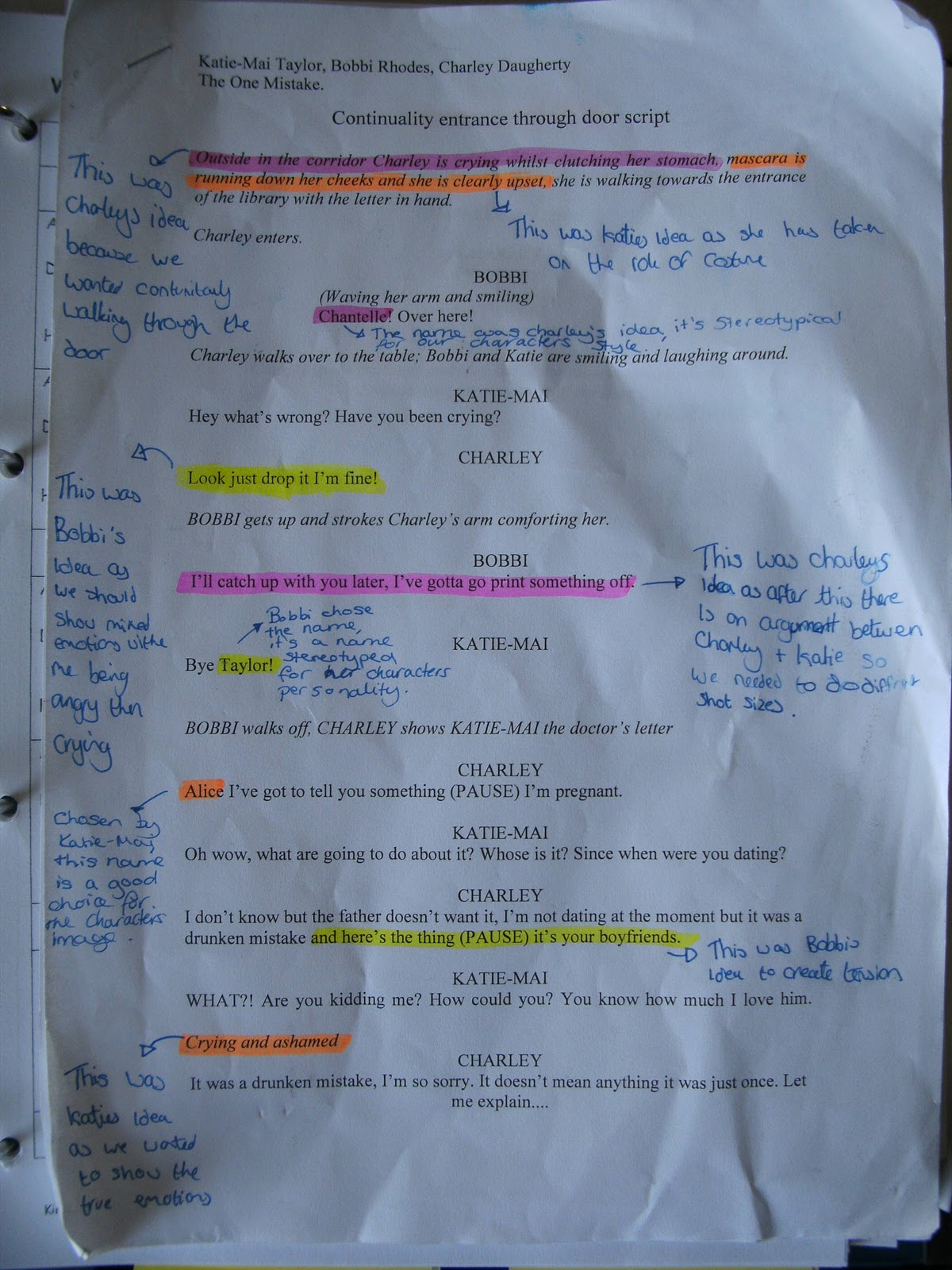
This is our groups script that we have annotated.On the script we have shown who thought of the ideas and how each member of the group contributted to the production of the script.
                                                           Types of contunuity problems would be, on the desk we plan to have work but if we have to do two differents days of filming the work may change postion.To over come this we plan to take a photo of the postion that the work is in. Also we may move the chairs to solve this we will but marks down where the chair legs are placed.

Tuesday, 20 September 2011

post 3: continuity


What is continuity?
http://en.wikipedia.org/wiki/Continuity_(fiction)
Keeping the mis-en-scene the same throughout filming and having the characters stand in the same place as where there was a 'cut'.

 This shows an example of continuity as there is 3 pens but then in the next shot there is only 2 with no infomation about where it has gone.


The 180 degree rule and crossing the line
 http://en.wikipedia.org/wiki/180_degree_rule
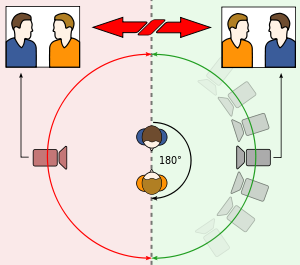
This is a rule that most movie makers stick to it allows the character to stay on the same side of the screen throughout filming.Such as if a character is on the left then that character will stay on the left.If the camera goes past the 180 degree shot it is crossing the line.


Shot reverse shot
This is when the camera switches its point of view, such as if two people were talking then one shot would be over one persons shoulder and the other shot will be other the next persons shoulder, they would be edited together.


What is match on action?
Match on action is where the production is cut from one shot to a different shot which usally makes a new view which matches the action from the first shot. Match on action gives an impression of continous time between the shots even if they were shot hours apart.

Monday, 19 September 2011

post 2: storyboard drawing,shot sizes and framing.

                                                                 Shot Sizes
I have scanned in a copy of my notes that I have made,this is to show what each shot looks like.


framing
This is an example of a extreme close up this is used to show facial expressions.

This is an example of a close up this shows the facial expression and also some background.

This is an example of a medium close up this shows the head and shoulders along with headroom.

This is an example of a medium shot this shows more headroom and more body below the shoulders.  

This is an example of a 3/4 shot it shows more of the background and more of the body. 


This is an example of a medium long shot it shows more head room and also more body.
This is an example of a long shot it shows headroom and also walking space.It also sets the scene as you see more of the mis-en-scene and you can use mis-en-scene to create the atmosphere
This is an example of shot reverse shot which is usally used during speech.


Rule of thirds
For the rule of thirds, imaginary lines are drawn dividing the image into thirds. The most important elements are placed where these lines intersect  In addition to using the intersections, it also helps to use a 2 to 1 ratio  so that nothing is dead center, which makes for a static image. Instead, when placing the horizon line of a landscape, or the eye line of a person, use the lower or upper third as an approximate guide.
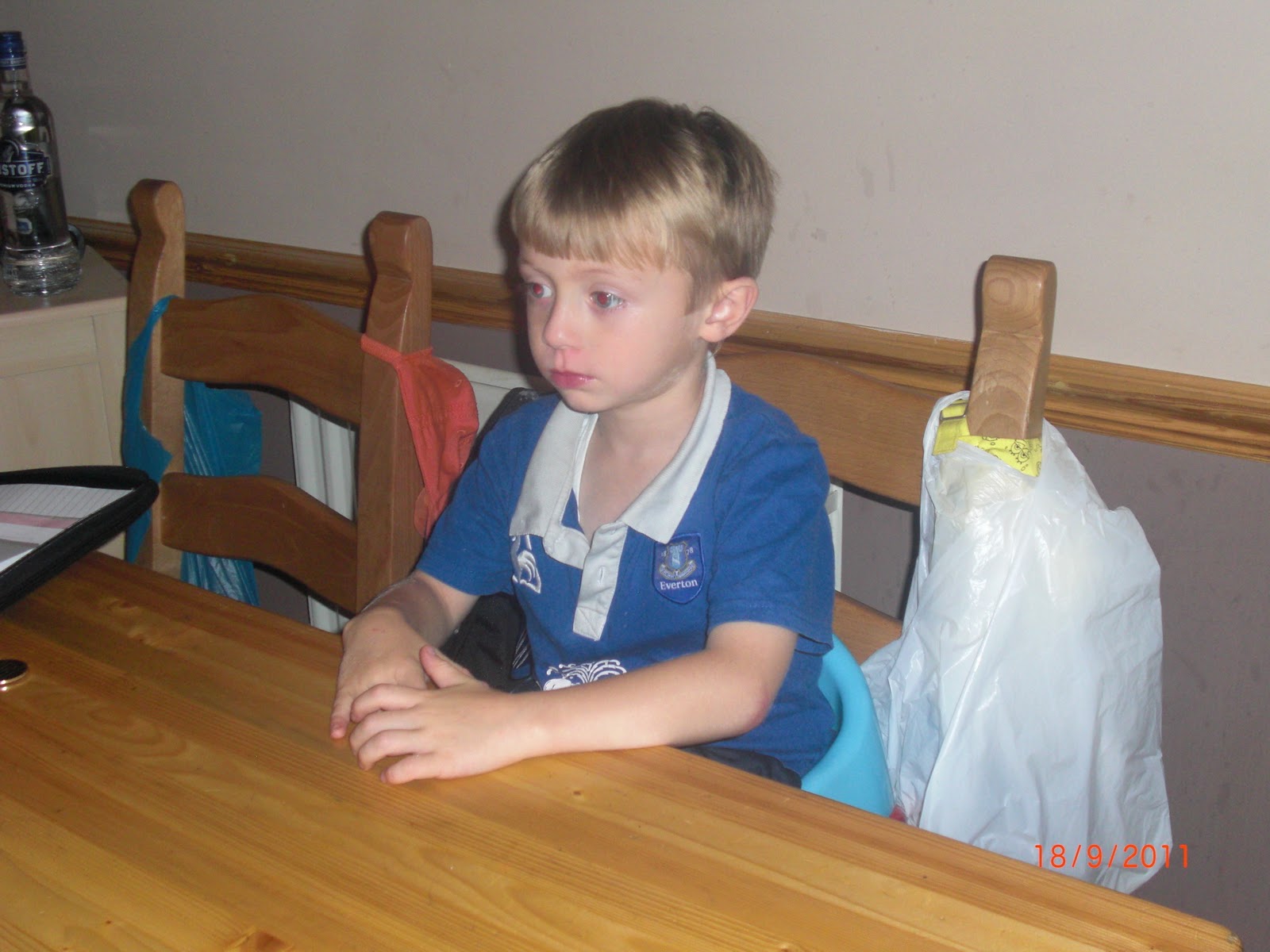
This is my example of rule of thirds.